Sunnah Foods as Foundations, Not Fads
Every few years, the wellness world rediscovers something new. Turmeric. Apple cider vinegar. Manuka honey. Black seed oil. Suddenly it is everywhere. Instagram posts. Supplement shelves. Morning routine videos. And then a year or two later, something else replaces it.
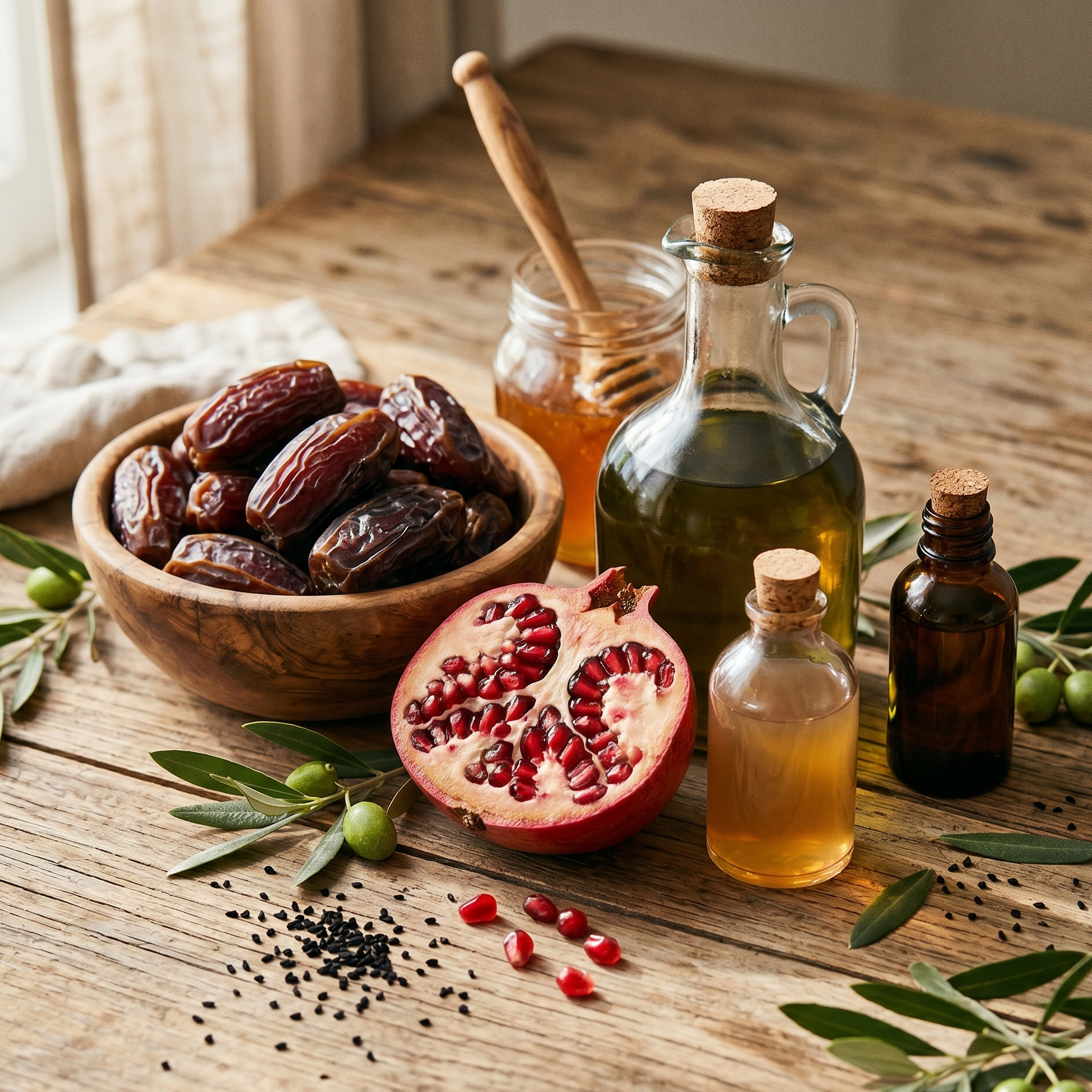
The strange thing is, for Muslims, many of these foods were never new. They have been part of daily life, mentioned in the Qur'an and practised by the Prophet ﷺ, for over fourteen hundred years. Not as fads. As foundations.
This blog is not about romanticising the past or dismissing modern science. It is about recognising that some foods have stood the test of centuries for a reason, and looking at both what tradition says about them and what the evidence now shows.
Honey: a remedy mentioned in the Qur'an
Honey is one of the few foods described in the Qur'an as containing healing. Allah says in Surah An-Nahl:
"And your Lord inspired the bees, saying: 'Take your habitations in the mountains and in the trees and in what they build. Then eat of all fruits, and follow the ways of your Lord made easy for you.' There comes forth from their bellies a drink of varying colours, wherein is healing for people. Verily in this is a sign for a people who reflect." (16:68-69)
The Prophet ﷺ also reportedly loved sweet things and honey, and in Sahih al-Bukhari there is a well-known narration where he advised a man whose brother had diarrhoea to drink honey. The brother recovered.
Modern research has confirmed what tradition always held. Raw honey has antibacterial, antimicrobial and wound-healing properties. It is used medically today to treat certain wounds and ulcers. It is rich in enzymes, antioxidants and trace minerals, particularly when it is raw and unprocessed.
For me personally, honey has been the single most impactful food on this list. When I was rebuilding my health, I used it as a practical tool to get rid of processed sugar almost completely. I started using it in everything. In drinks, in cooking, occasionally in baking. It was not about eating more sugar overall. It was about replacing the refined stuff with something that came with nutrients, not empty calories.
That bridge matters. Most people cannot go from processed sweets straight to nothing. Having raw honey as a natural alternative makes the transition easier. You still get the satisfaction of something sweet, but without the crash and without the harm.
Black seed: "healing for every disease except death"
One of the most striking narrations in the whole body of Prophetic medicine is this one, reported in Sahih al-Bukhari:
"Use the black seed regularly, because it is a cure for every disease except death." (Bukhari 5687)
That is a remarkable statement. For centuries, Muslims have taken it seriously and used black seed, known as Nigella sativa, as a daily supplement for general wellbeing and specific ailments. In Arabic it is called Habbat al-Barakah, "the blessed seed."
The science has caught up in a big way. Black seed contains a compound called thymoquinone, which has been studied for its anti-inflammatory, antioxidant, antimicrobial and immune-supporting properties. Research has looked at its potential role in managing blood sugar, respiratory conditions, skin issues and chronic inflammation. Of course, no single food is a cure-all in the clinical sense. But the range of mechanisms through which black seed appears to support the body is unusually broad.
I took it daily during my holistic period. I still take it now. Whether in seed form, as oil, or infused into raw honey, it is one of those foods I genuinely believe earns its place in a daily routine.
Olive oil: from a blessed tree
The olive tree is mentioned in the Qur'an multiple times, and Allah swears by it in Surah At-Tin:
"By the fig and the olive, and by Mount Sinai, and by this city of security, indeed We have created man in the best of stature." (95:1-4)
The Prophet ﷺ also said:
"Eat olive oil and anoint yourselves with it, for it comes from a blessed tree." (Tirmidhi 1775)
This is one of the most practical Sunnah foods to bring into everyday life. Modern nutrition research, particularly around the Mediterranean diet, has shown that extra virgin olive oil is associated with reduced risk of heart disease, cognitive decline, chronic inflammation and certain cancers. It is rich in monounsaturated fats and polyphenols, which have been studied extensively for their protective effects.
The key is quality. Most supermarket olive oils are heavily processed, refined or blended with cheaper oils. Real extra virgin olive oil, cold pressed and stored properly, is a completely different product. If you use it often, it is worth buying the best you can afford.
Dates: more than just for breaking fasts
Dates are woven into Muslim life in a way few other foods are. The Prophet ﷺ would often break his fast with them, and there is a specific hadith narrated in Sahih al-Bukhari regarding Ajwa dates:
"Whoever eats seven Ajwa dates in the morning, neither magic nor poison will harm him that day." (Bukhari 5445)
Dates are nutrient dense. They contain potassium, magnesium, fibre, antioxidants and natural sugars that are absorbed more slowly than refined sugar because of the fibre content. They are one of the best examples of a food that is sweet, satisfying and still supportive of the body.
For anyone trying to reduce processed sugar, dates are a powerful tool. Two or three dates with a handful of nuts is a genuinely filling snack. Blended into smoothies, mashed into porridge, or simply eaten on their own, they give you sweetness with substance.
Apple cider vinegar: a simple practice with deep roots
The Prophet ﷺ said, as reported in Sahih Muslim:
"The best of condiments, or condiment, is vinegar." (Muslim 2051)
In another narration, his wife Aisha (may Allah be pleased with her) said the Prophet praised vinegar and spoke of it favourably when it was brought to him.
It is worth noting that the vinegar referred to here is naturally fermented vinegar, produced directly from fruit or grain. Raw, unfiltered apple cider vinegar made this way carries that Sunnah praise.
Modern research has shown apple cider vinegar may support blood sugar regulation, improve digestion, and help with satiety when taken before meals. A small amount in water before a heavy meal is a simple habit that many people find genuinely helpful. It is one of the easiest Sunnah-aligned additions you can make to a daily routine.
Pomegranate: the fruit of Paradise
Pomegranate is mentioned three times in the Qur'an, including in Surah Ar-Rahman, which describes it among the blessings of Paradise:
"In both of them are fruits and palm trees and pomegranates." (55:68)
Pomegranates are one of the most antioxidant-dense fruits in existence. They contain punicalagins and other polyphenols that have been studied for their role in heart health, anti-inflammatory effects and gut health. Some emerging research has looked at pomegranate's effect on Akkermansia muciniphila, a beneficial gut bacterium linked to metabolic health and a stronger gut barrier.
It is not a supplement you need to buy. Just eating fresh pomegranate seeds regularly, or drinking good quality pomegranate juice occasionally, is enough to benefit.
Why these foods matter more than any trend
The thing that unites all of these foods is this: they do not need an influencer to validate them. They have been used, trusted and recommended across generations, cultures and centuries. Modern science is not discovering their value. It is catching up to what was already known.
That does not mean we reject science. Far from it. The beauty is in the overlap. When the Qur'an, the Sunnah and peer-reviewed research all point in the same direction, you can build your routines with real confidence.
You do not need to consume all of these every day. But bringing a few of them into your weekly rhythm, a spoonful of raw honey in the morning, olive oil on your meals, black seed oil in a small daily dose, dates as your afternoon snack, is not faddy. It is foundational. And it has been foundational for a very long time.
Where The Raw Kitchen fits in
Much of what we stock comes from this same starting point. Raw honey, black seed oil, apple cider vinegar, infused honeys including black seed and cinnamon. These are not products we chose because they are trendy. They are products I trusted during my own recovery and continue to use now. The standard we hold is simple: if it would not earn a place in my own daily routine, it would not be on our shelves.
If you want to bring one of these foods into your week, start with something you do not currently have. Maybe it is switching from table sugar to raw honey. Maybe it is a daily spoon of olive oil drizzled over your dinner. Maybe it is a capful of apple cider vinegar before a heavy meal. Small shifts, layered over time, build the kind of routine that does not need a new trend every year.



Leave a comment
This site is protected by hCaptcha and the hCaptcha Privacy Policy and Terms of Service apply.