Iron, Fatigue and Why So Many Women Feel Exhausted
There is a particular kind of tiredness that sleep does not fix. You go to bed at a reasonable hour. You wake up and still feel like you have been hit by something. Climbing the stairs leaves you more out of breath than it should. Your concentration is patchy. Your hair seems thinner than it was. And when you finally mention it to someone, the response is usually some version of "well, you are busy, what do you expect?"
If that sounds familiar, and particularly if you are a woman who still has periods, there is a specific thing worth ruling out before you accept exhaustion as your baseline. Your iron.
How common this actually is
Iron deficiency is the most common nutritional deficiency in the world, and women of reproductive age are by far the most affected group.
In the UK's own National Diet and Nutrition Survey, around 15% of women aged 19 to 64 had ferritin levels below 15 nanograms per millilitre, which is the threshold generally used to confirm depleted iron stores. That is roughly one in seven women walking around with genuinely low iron reserves. In women with heavy periods, the figures are far higher. Studies of women with heavy menstrual bleeding have found iron deficiency in the majority of them.
The reason is simple and unglamorous. Every period costs you iron. If your losses each month exceed what you are taking in and absorbing from food, your stores gradually run down. It is not dramatic. It happens quietly, over months and years, which is exactly why so many women do not spot it.
The bit that catches people out: you can be deficient without being anaemic
Now this is the most important thing in this whole blog.
Most people think of iron problems as "anaemia," and they assume a normal blood test rules it out. But anaemia is the final stage, not the first. Your body holds iron in storage, and that storage is measured by something called ferritin. When your intake does not keep up with your losses, your ferritin stores deplete first. Your haemoglobin, the thing measured on a standard full blood count, stays normal for a long time afterwards, because your body prioritises keeping it up.
So you can have significantly depleted iron stores, feel genuinely awful, and be told your blood test is "fine," because the test that was run only looked at haemoglobin.
Research bears this out. Meta-analyses have found that iron deficiency without anaemia is a real cause of fatigue, and that women in this position often improve when their iron stores are restored. Many women sit in that grey zone for years, being told there is nothing wrong, while feeling far from well.
What low iron actually feels like
The symptoms are broad, which is part of why it gets missed. Common ones include:
Persistent fatigue that does not resolve with rest. Feeling breathless doing things that did not used to be an effort, like stairs or carrying shopping. Brain fog and difficulty concentrating. Hair thinning or increased shedding. Pale skin, or unusually pale inner eyelids. Feeling cold, particularly in the hands and feet. Headaches. Low mood. Brittle nails. Restless legs at night, especially in the evening. And occasionally, cravings for strange non-food things like ice, which has a name, pica, and is a classic sign.
Notice how many of those get shrugged off as normal life. That is the problem.
Who is most at risk
Women with heavy or long periods, by a wide margin. Pregnant and postpartum women, since pregnancy dramatically increases iron demand. Vegetarians and vegans, because plant-based iron is harder for the body to absorb. Teenage girls, particularly after periods start, as growth and menstruation compete for the same stores. Endurance athletes. Anyone with digestive conditions like coeliac disease or IBD that affect absorption. And people on long-term medications like proton pump inhibitors, which reduce stomach acid and therefore reduce iron absorption.
Get tested. Properly.
Here is my honest, practical advice: if this sounds like you, go to your GP and ask specifically for a ferritin test, not just a full blood count. Ask for the actual number rather than "it's normal," because the reference ranges are wide, and a ferritin of 16 is technically "in range" while still being low enough to cause real symptoms in many people.
It is also worth asking about vitamin D and B12 at the same time, since they share overlapping symptoms and deficiencies often travel together in the UK.
I am not a doctor and I would never tell you to self-diagnose or start taking iron supplements on a hunch. Taking iron you do not need is genuinely harmful, because excess iron accumulates and can damage organs. This is one where you get the blood test first, and let the results guide what happens next. If you are deficient, your GP will guide treatment, and that is exactly as it should be.
What food can genuinely do
Where food comes in is in supporting your intake and, crucially, your absorption. This will not fix a serious deficiency on its own, but it makes a real difference to maintaining healthy levels once you are on track, and it is entirely within your control.
Understand the two types of iron. Haem iron, found in meat, poultry and fish, is absorbed far more efficiently by the body, at roughly 15 to 35%. Non-haem iron, found in plants like lentils, beans, spinach, tofu, nuts and fortified cereals, is absorbed much less efficiently, at around 2 to 20%. This is why vegetarians and vegans need to be more deliberate about it.
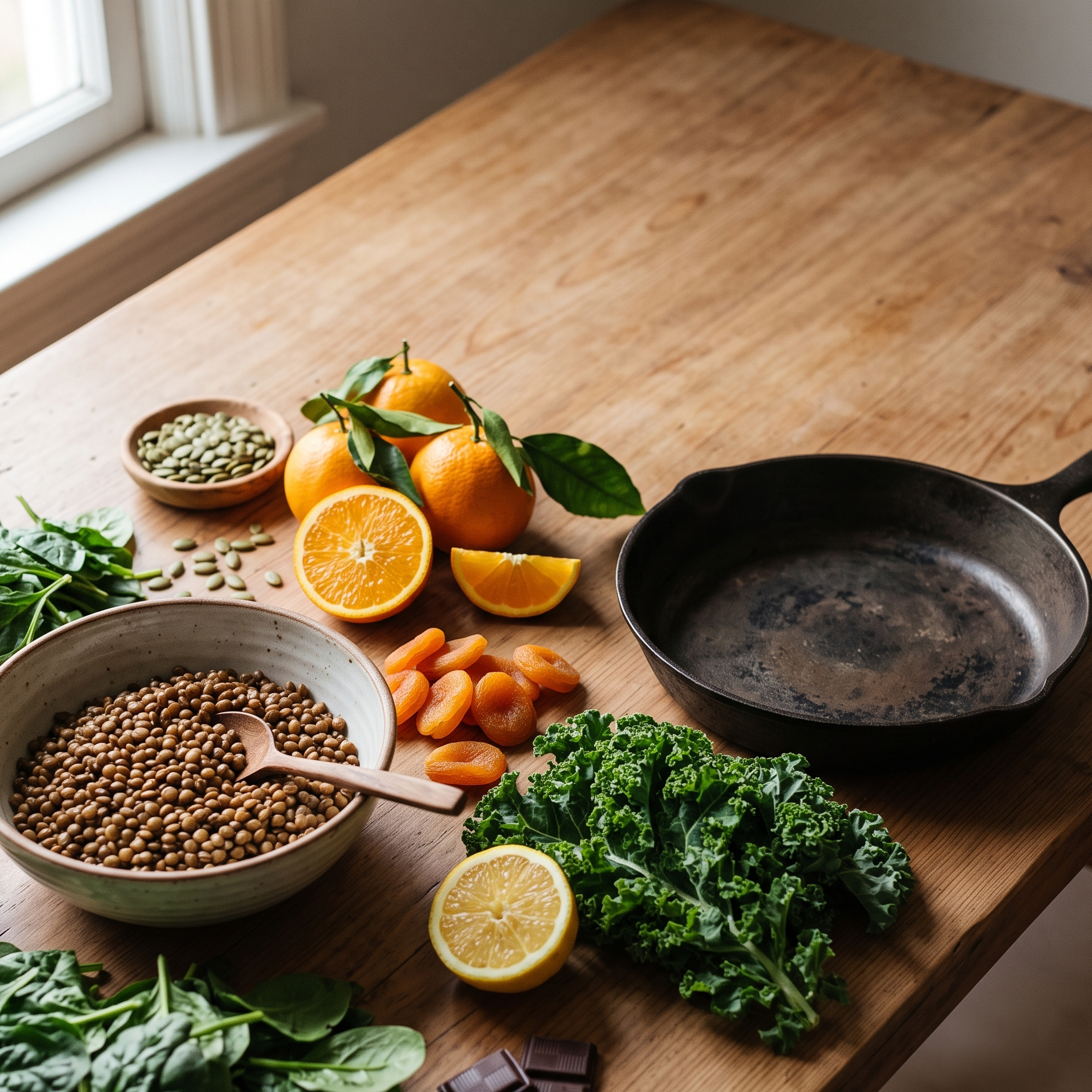
Pair iron with vitamin C. This is the single most useful trick. Vitamin C dramatically increases the absorption of non-haem iron. Squeeze lemon over your lentils. Have peppers or tomatoes with your beans. Eat an orange alongside your fortified porridge. The difference in absorption is substantial and it costs you nothing.
Watch what blocks it. Tea and coffee contain tannins that significantly inhibit iron absorption, and this is a big one in British households. A cup of tea with your meal can cut the iron you absorb from it considerably. Try to leave an hour either side of meals. Calcium also competes with iron, so a large glass of milk alongside your iron-rich meal is not ideal timing.
Cook in cast iron. Genuinely, cooking in a cast iron pan transfers a small but meaningful amount of iron into your food, particularly with acidic foods like tomato-based dishes.
Eat the good sources regularly. Red meat, liver, sardines, lentils, chickpeas, beans, dark leafy greens, pumpkin seeds, dried apricots and dark chocolate all contribute.
Where our products fit, honestly
I am not going to pretend a jar of honey treats iron deficiency, because it does not, and anyone telling you otherwise is selling you something.
What I will say is that broad mineral support is a sensible part of the picture. Our Avocado Raw Honey is one of the more mineral-rich honeys we stock, traditionally valued for its higher iron content alongside potassium, magnesium and phosphorus, and it has long been used in traditional practice as a support for those dealing with symptoms of anaemia. Our Sea Moss carries 92 of the 102 essential minerals the body uses, including iron, and is a gentle way to broaden your mineral intake generally.
Think of these as part of a well-built foundation, working alongside a good diet, not as a replacement for a blood test and proper medical care if you are genuinely deficient. That distinction matters.
The takeaway
If you have been exhausted for months and have quietly accepted it as the price of a busy life, please do not. Especially if you are a woman with heavy periods, if you are vegetarian, or if you have recently had a baby.
Go and get your ferritin checked. Ask for the number. Support it with food, pair your iron with vitamin C, and go easy on the tea with meals.
Feeling permanently drained is common, but it is not normal. And in a lot of cases, it is genuinely fixable.


Leave a comment
This site is protected by hCaptcha and the hCaptcha Privacy Policy and Terms of Service apply.